London Soundproofing Secrets Revealed: What Most Window Companies Won't Tell You About Sash Windows

For owners of period properties in Kensington, Chelsea, and Westminster, the city of London offers a vibrant cultural tapestry — often accompanied by a relentless acoustic assault. The roar of the District Line, the piercing sirens of emergency vehicles, and the constant hum of metropolitan traffic can transform a historic residence from a sanctuary into a site of sensory exhaustion.
When residents seek relief, the standard advice from most window companies is predictable: "Replace your original sash windows with modern double glazing." However, for those living in listed buildings or conservation areas, this is often legally impossible and, scientifically speaking, suboptimal for noise reduction.
This report reveals the critical technical secrets that standard window companies often overlook, and why specialist acoustic secondary glazing remains the definitive remedy for urban noise.
Section 1: The Acoustic Fallacy of Standard Replacements
Many homeowners believe that installing new double-glazed sash windows will solve their noise problems. This is an expensive misconception. Standard double glazing is designed primarily for thermal efficiency, not acoustic isolation.
1.1 The "Triple Leaf" Effect and Resonance
Standard double-glazed units typically feature a narrow 16mm to 20mm gap between the glass panes. In acoustic terms, this small cavity can actually lead to a phenomenon known as the "mass-air-mass resonance." If you replace your original windows with double glazing, you often create a "triple leaf" effect: three layers of glass with two small air gaps — which can vibrate in sympathy with low-frequency traffic noise, effectively acting like a drum.
As London's only dedicated specialists for acoustic secondary glazing, we understand that sound does not behave like heat. To block sound, you need decoupling and mass.

Section 2: The Three Pillars of Acoustic Restoration
🏛️ Living in a listed building or conservation area?
See how we navigate planning permission and protect your heritage windows. Read our conservation area guide →
To achieve a reduction of up to 54dB — a level that renders high-decibel city noise virtually imperceptible — an installation must adhere to what we call the "Three Pillars of Acoustic Restoration."
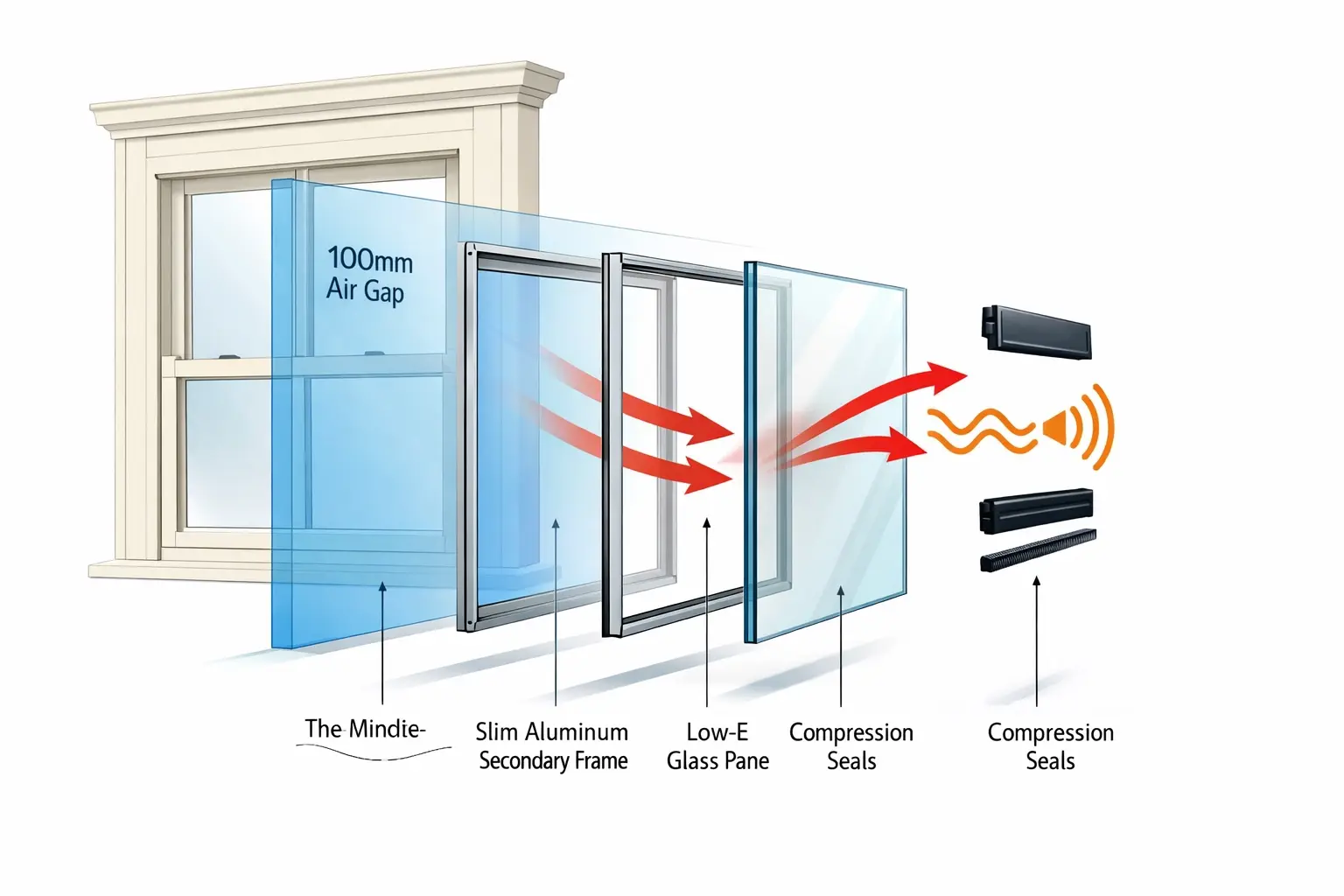
2.1 Pillar One: The Massive 10.8mm Acoustic Laminate
Most window companies use 4mm or 6mm glass. We utilize 10.8mm acoustic laminate glass. This isn't merely thicker glass; it is a "sandwich" of two glass sheets bonded by a specialist viscoelastic PVB (Polyvinyl Butyral) interlayer.
This interlayer acts as a dampening core. When sound waves hit the glass, the interlayer converts the acoustic energy into a minute amount of heat rather than allowing the vibration to pass through. This is the difference between a "ring" and a "thud."
2.2 Pillar Two: The Critical 100-150mm Air Gap
Acoustic energy follows a logarithmic scale. To truly decouple the interior environment from the exterior chaos, a significant air gap is required. Standard double glazing fails here with its 20mm gap. Our system utilizes a precision 100-150mm air gap.
This massive cavity ensures that the two panes of glass act independently. By increasing the distance between the primary window and the secondary glazing, we push the resonance frequency of the system below the audible range of human hearing, specifically targeting the low-frequency rumble of buses and HGVs.

2.3 Pillar Three: The Airtight Envelope and EPDM Seals
Acoustic performance is binary: if air can pass through, sound can pass through. Even a 1% gap in a window seal can lead to a 10dB loss in performance. Standard brush seals found in most sash windows are porous and acoustically transparent.
We employ twin-compression EPDM (Ethylene Propylene Diene Monomer) seals. These high-grade gaskets create a totally airtight acoustic envelope. When the secondary unit is closed, it compresses these seals to form a bastion against noise and drafts, ensuring the benefits are felt immediately.
Section 3: The Conservation Verdict — Listed Building Approval
One of the greatest frustrations for residents in Westminster or Chelsea is the restriction placed on listed buildings. Replacing original timber frames is frequently prohibited by conservation officers.
Our system provides the ultimate loophole. Because our secondary glazing is installed on the internal reveal, it is considered a reversible alteration. It does not touch or damage the original fabric of the historic window. Consequently, we maintain a 100% conservation officer approval rate. We restore the tranquility of your home without compromising its heritage value.

Section 4: Real-World Evidence — From Sirens to Silence
The following table synthesizes the performance metrics of various window configurations, highlighting the superior efficacy of our specialized approach:
| Window Configuration | Typical Decibel Reduction | Subjective Perception |
|---|---|---|
| Single Glazed Sash | 20-25dB | High intrusion of all noise |
| Standard Double Glazing | 30-32dB | Traffic still audible |
| Acoustic Double Glazing | 38-40dB | Sirens clearly audible |
| Specialist Secondary (10.8mm / 150mm) | Up to 54dB | The sound of a gentle breeze |
Note: A 10dB reduction is perceived by the human ear as a 50% reduction in volume. A 54dB reduction represents a transformative shift in the home environment.
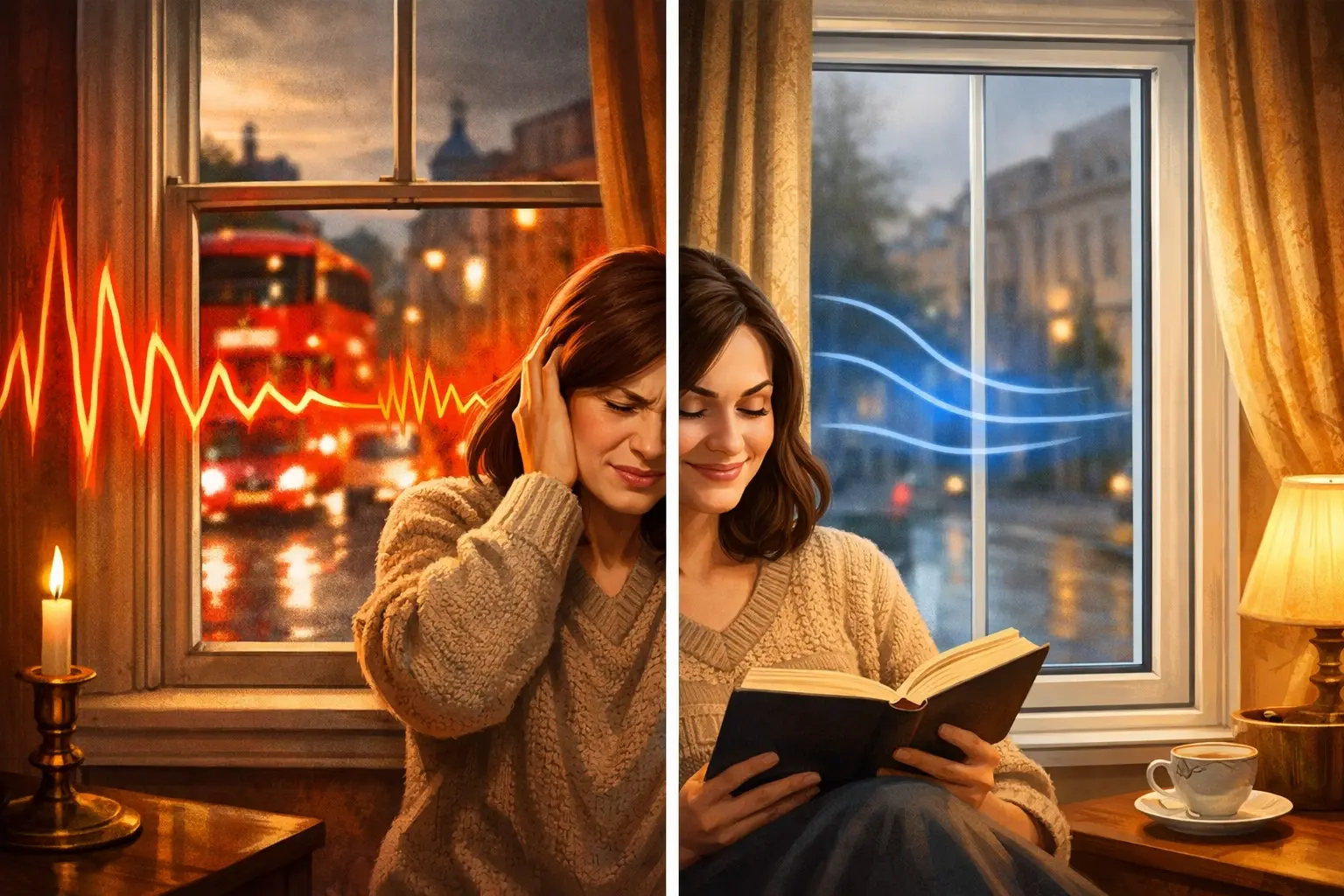
In our case studies, clients often describe "The Moment It Clicks": that second when the final pane is closed and the roar of London simply vanishes. It is not just about decibels; it is about the restoration of mental health and the elimination of sleep deprivation.

Actionable Guidance: Evaluating Your Home's Acoustic Defense
💷 Wondering about costs?
Use our calculator to get an instant estimate for your windows. Try the cost calculator →
If you are currently evaluating your soundproofing options, consider this assessment checklist:
- The Glass Test: Does the proposal include at least 10.8mm laminate with a PVB interlayer?
- The Gap Analysis: Is the proposed air gap at least 100mm? Anything less is a compromise.
- The Seal Inspection: Are the seals brush-based (ineffective) or compression-based EPDM (effective)?
- Warranty Security: Does the company offer a massive 25-year warranty on the installation?
The Verdict: An Intelligent Investment
For the discerning homeowner, secondary glazing is not a mere purchase; it is an intelligent investment in the structural integrity and emotional sanctuary of your property. Standard window companies may offer a "fix," but they rarely provide a "solution."
By understanding the physics of sound — decoupling, mass, and airtightness — you can bypass the trial-and-error of standard glazing and proceed directly to a predictable, laboratory-proven outcome.
Ready to restore the peace your home deserves? Request a professional assessment today and discover the art of silence.
"Brilliant installation — completely invisible from outside. Conservation officer approved."
— David L., Westminster
Planning a project?
Get an instant estimate with our Secondary Glazing Cost Calculator or Book a Professional Sound Survey.