Secondary Glazing for Listed Buildings London: The Complete Guide to Conservation-Approved Soundproofing
You live in a listed period property in London — perhaps a Georgian townhouse in Kensington, a Victorian villa in Chelsea, or a Grade I-listed residence in Westminster. The architecture is extraordinary. The proportions are elegant. The craftsmanship is irreplaceable. The noise from outside, however, can feel relentless.
This is the central contradiction of heritage living in the capital. Your home is a sanctuary in visual terms, yet acoustically it can be under constant assault from buses, sirens, late-night traffic, delivery vehicles, aircraft paths, and the low-frequency rumble that settles into old streets. The human cost is not abstract. It often means broken sleep, reduced concentration, elevated stress, and the gradual loss of the tranquility your home should provide.
The obvious answer might seem to be new windows. In a listed building, that route is usually closed. Replacing original sash or casement windows will often trigger listed building consent concerns because historic fabric, sightlines, glazing bars, timber profiles, and operational details are all part of the building's special architectural or historic interest.
So what do you do when you need meaningful noise reduction without violating heritage controls? The answer is acoustic secondary glazing — a conservation-approved, fully reversible intervention that can reduce external noise by up to 54dB while leaving your original windows intact.
Understanding Listed Building Grades for Windows
Grade I
Grade I buildings are the most protected category. Alterations to original windows typically require full listed building consent, and conservation officers will expect a compelling case for minimal intervention. Reversibility is especially important, and the visual impact of any change must be extremely limited.
Grade II*
Grade II* buildings are also highly protected. Original frames, sash boxes, cords, weights, and sightlines are likely to be protected. Planning support and a conservation-aware specification are essential.
Grade II
Grade II is the most common classification, accounting for roughly 92% of listed buildings. Any alteration to windows still requires careful planning, and heritage officers often prefer retention and repair over wholesale substitution.
Why Secondary Glazing Fits the Heritage Logic
Acoustic secondary glazing is generally understood as a like-for-like internal addition rather than a replacement. It keeps the external appearance unchanged, leaves the original sash or casement in place, preserves heritage fabric, and can be removed in future without permanent harm.
The planning-aware track record on listed-building submissions
🏛️ Living in a listed building or conservation area?
See how we navigate planning permission and protect your heritage windows. Read our conservation area guide →
Our acoustic secondary glazing system is specified to satisfy the core concerns conservation officers raise most often:
- Completely reversible — can be removed without destroying original timber or period detailing.
- No permanent fixings — no irreversible intervention into the historic frame.
- Maintains original sightlines and operation — preserves historic glazing lines, proportions and daylight pathways.
- Preserves sash cords, weights and existing frames — retains the elements that carry the building's significance.
We work directly with conservation officers across Kensington, Westminster, Chelsea, Camden, Islington and Richmond, because planning success depends on presenting the intervention in the right way: clearly reversible, acoustically justified, visually discreet, and respectful of historic operation and detailing.
Acoustic Secondary Glazing vs Standard Double Glazing vs DIY Magnetic
| Feature | Acoustic Secondary Glazing | Standard Double Glazing | DIY Magnetic |
|---|---|---|---|
| Noise reduction | Up to 54dB | 28–35dB | 10–20dB (real conditions) |
| Listed building approval | Strong pathway | Often problematic | Variable |
| Reversibility | Fully reversible | No — originals removed | Partial |
| Air gap | 100–150mm | Narrow sealed unit | Minimal |
| Glass thickness | 10.8mm acoustic laminate | Standard IGU | ~4mm acrylic/glass |
| Preserves original frames | Yes | No | Usually yes |
| Warranty | 25 years | Varies | Limited |
| Suitability for listed buildings | Excellent | Poor | Limited |
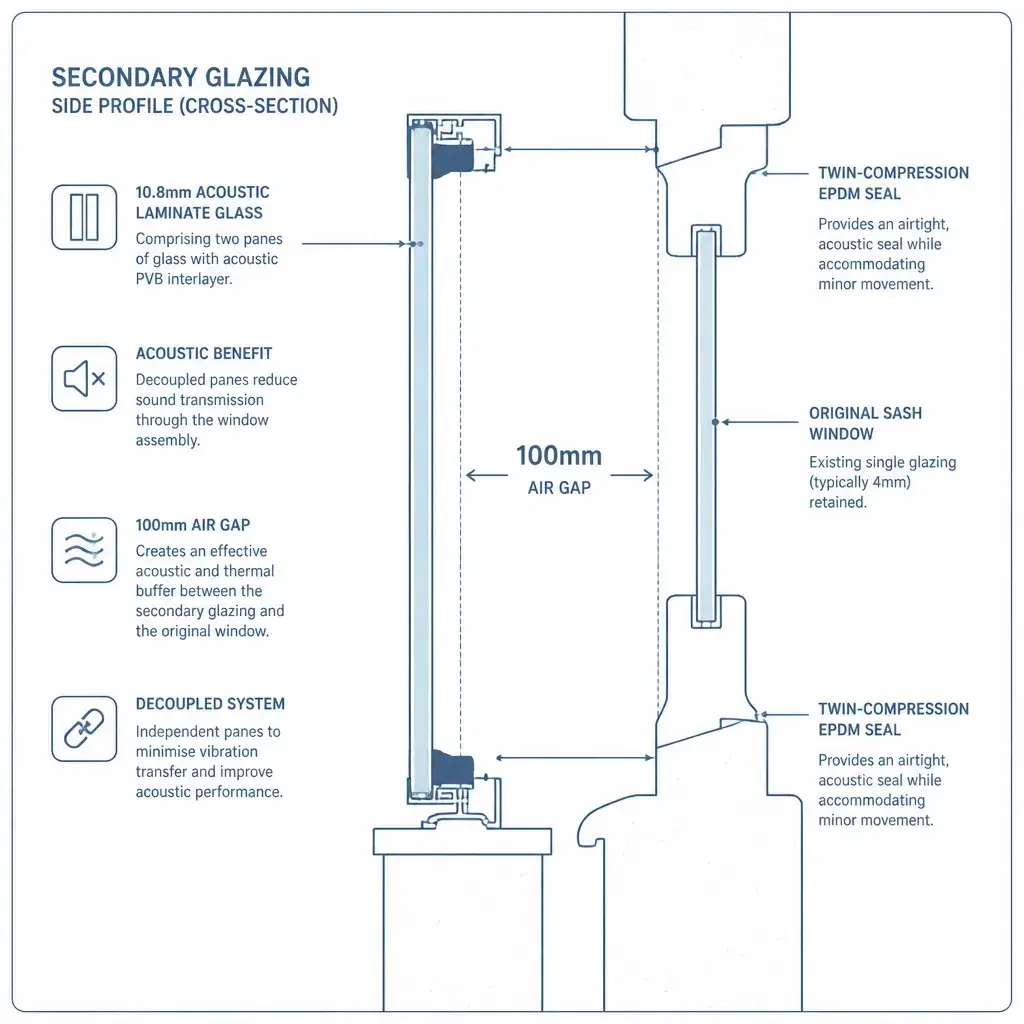
Noise control is not delivered by glass thickness alone. It depends on the combination of glass mass, acoustic laminate behaviour, decoupling distance, and airtight sealing.
The Three Pillars of Heritage Soundproofing
Pillar One: 10.8mm Acoustic Laminate Glass with PVB Interlayer
At the core of the system is 10.8mm acoustic laminate glass with a viscoelastic PVB interlayer between glass plies. That interlayer damps vibration as sound waves attempt to pass through the pane — particularly across the frequencies that make urban living tiring: traffic hiss, tyre roar, sirens and bus acceleration. Learn more in our acoustic glass physics guide.
Pillar Two: Precision 100–150mm Air Gap for Acoustic Decoupling
The most powerful acoustic tool in secondary glazing is often not the glass itself but the air gap. A precision 100–150mm cavity creates acoustic decoupling — the two barriers are spaced far enough apart that sound energy loses coherence as it tries to travel from one layer to the other. Because decibels are logarithmic, a substantial reduction can feel transformational.
Pillar Three: Twin-Compression EPDM Seals
Sound behaves like water: it finds gaps. Twin-compression EPDM seals create an airtight acoustic envelope, eliminating the flanking leakage paths that undermine lesser systems. EPDM is durable, flexible over time and resistant to compression fatigue.
The Heritage Process
💷 Wondering about costs?
Use our calculator to get an instant estimate for your windows. Try the cost calculator →
1. Free Site Survey
Window type and condition, depth of reveal, sash movement and access, street exposure, noise source profile and heritage sensitivities are all evaluated. Book a free sound survey.
2. Heritage Assessment
Identifies which features must be preserved — original joinery, architraves, shutters and sightlines — and how the secondary glazing can be introduced without compromising them.
3. Sensitive Design and Planning Support
Where acoustics and conservation are reconciled: minimal visual intrusion, appropriate frame detailing, reversible installation logic, and access for opening and cleaning. See our planning permission guide.
4. Expert Installation
Typically 1–3 days, depending on the number of windows and complexity of access. Millimetre-accurate tolerances protect fragile heritage interiors.
5. Final Acoustic Seal
Airtight performance is completed at the sealing stage — the detail that separates premium performance from mediocre outcomes.
Real-World Results
In our documented Kensington Cromwell Road case study, equivalent before-and-after measurements recorded a reduction from 78dB to 26dB under the stated test conditions. Results vary with the existing window, glass, air gap, seals, room construction and noise source.
At around 75dB, traffic noise dominates the room. At around 21dB, the acoustic character changes completely — clients often describe it as "like a gentle breeze instead of a bus route." Better sleep, improved concentration, less startle response to sirens, and a home that finally feels aligned with its visual beauty. Explore more London case studies.
Why This Beats the Alternatives
Standard double glazing usually requires replacing historic frames, which conflicts with listed building controls and cannot preserve original sash boxes, cords and weights. See our secondary vs double glazing comparison.
DIY magnetic systems rely on thin 4mm glazing, minimal perimeter robustness and little to no meaningful air gap — reduced acoustic mass, weak decoupling, inferior sealing and limited durability.
Only specialist acoustic secondary glazing combines up to 54dB in suitable configurations, full conservation-aligned reversibility, 10.8mm acoustic laminate, a 100–150mm cavity, twin-compression EPDM seals and a 10-year standard / 25-year Premium & Heritage warranty.
Conclusion
Your period property should not be a noise trap. The intelligent goal is to preserve both heritage and comfort. Acoustic secondary glazing leaves original windows untouched, supports listed-building approval pathways, and can reduce intrusive city noise by up to 54dB through acoustic laminate glass, a precision decoupling cavity and airtight EPDM sealing.
Book a free survey today and get a professional assessment of how conservation-approved acoustic secondary glazing can transform your listed property.
Frequently Asked Questions
Solutions covered in this guide
Go straight to the dedicated London landing page for the system or property type discussed above.
- Secondary glazing for listed buildingsFully reversible, consent-friendly specifications for Grade I and Grade II properties.
- Conservation area secondary glazingWhat London conservation officers accept — sightlines, finishes and reversibility.
- Lift-out secondary glazingThe most discreet, highest-sealing option for rarely-opened heritage windows.
- Secondary glazing for sash windowsPurpose-built systems for London box sash windows — specs, prices and heritage detailing.
Sources & References
Authoritative sources supporting the information on this page.
- Historic England (2016). Energy Efficiency and Historic Buildings: Secondary Glazing for Windows. Historic England.Open source
Technical advice on choosing and installing secondary glazing in older and listed buildings.
- British Standards Institution (2014). Guidance on sound insulation and noise reduction for buildings (BS 8233:2014). BSI Standards.
Sets the recommended internal noise levels for bedrooms and living rooms used to judge how much glazing performance a home needs.
- HM Government (2015). Approved Document E: Resistance to the passage of sound. The Building Regulations 2010.Open source
The statutory guidance on sound insulation in dwellings in England.
- British Standards Institution (2020). Acoustics: Rating of sound insulation in buildings and of building elements, Part 1: Airborne sound insulation (BS EN ISO 717-1). BSI Standards.
Defines the Rw and Rw+Ctr ratings used to compare the acoustic performance of glazing systems.
- British Standards Institution (2019). Glass in building: Glazing and airborne sound insulation (BS EN 12758). BSI Standards.
Describes how the sound insulation of glass types, including acoustic laminates, is characterised.
"We can actually sleep now. The 10.8mm glass made all the difference."
— Sarah M., Kensington
Planning a project?
Get an instant estimate with our Secondary Glazing Cost Calculator or Book a Professional Sound Survey.
Related services & guides
Move beyond the blog: jump straight to the matching service pages, cost tools and technical guides that go deeper on this topic.
- Specialist acoustic glazing service
The full acoustic glazing menu with dB targets and pricing.
- Transparent London secondary glazing pricing
Fixed 2026 prices per window with no hidden extras.
- ROI & payback calculator
Instant estimate for your window count, glass spec and property type.
- Request a free bespoke quote
Same-week written quote based on your exact requirements.
Related Articles
How to Choose the Best Secondary Glazing for Sash Windows (Compared)
Secondary Glazing for Sash Windows: The Complete London Guide (54dB Noise Reduction)