
The Physics of Silence: How to Block London's Low-Frequency Rumble
If you live in London, you know the sound. It's not the sharp squeal of brakes or the occasional siren that wakes you up at 3am. It's the rumble. That low, bone-rattling vibration that comes through your beautiful Victorian sash windows every time a double-decker bus trundles past or a lorry downshifts at the junction outside.
You can feel it in your chest. You can feel it in your tea mug on the windowsill. And no matter how tightly you shut your windows, it just keeps coming through like it's mocking you.
Here's the frustrating bit: standard double glazing — even the pricey stuff — barely touches it. You might have spent thousands replacing your windows thinking it would solve the problem, only to discover that the rumble persists. The traffic sounds a bit quieter, sure, but that deep, thudding vibration? Still there.
So what's going on? Why does low-frequency noise seem to ignore your windows entirely?
Why Low-Frequency Noise is a Proper Nightmare
The problem comes down to physics. Specifically, wavelength.
High-pitched sounds — like a car horn or someone's phone ringing — have short wavelengths. They're relatively easy to block because they don't have the energy to push through solid materials. Standard glass does a decent job with these.
But low-frequency sounds — like the rumble of a diesel engine or construction machinery — have wavelengths that can stretch over 20 feet. A 50 Hz sound (think of a heavy lorry idling) creates a wave that's about 6.8 metres long. That's longer than most London living rooms.
When a sound wave is that big, it doesn't just bounce off your window. It vibrates the glass itself, turning your window into a giant speaker cone that transmits the sound straight into your home. The thinner the glass, the more it vibrates. And the more it vibrates, the more noise gets through.
This is why you can still hear buses and lorries even with your windows closed. The glass isn't blocking the sound — it's practically amplifying it.
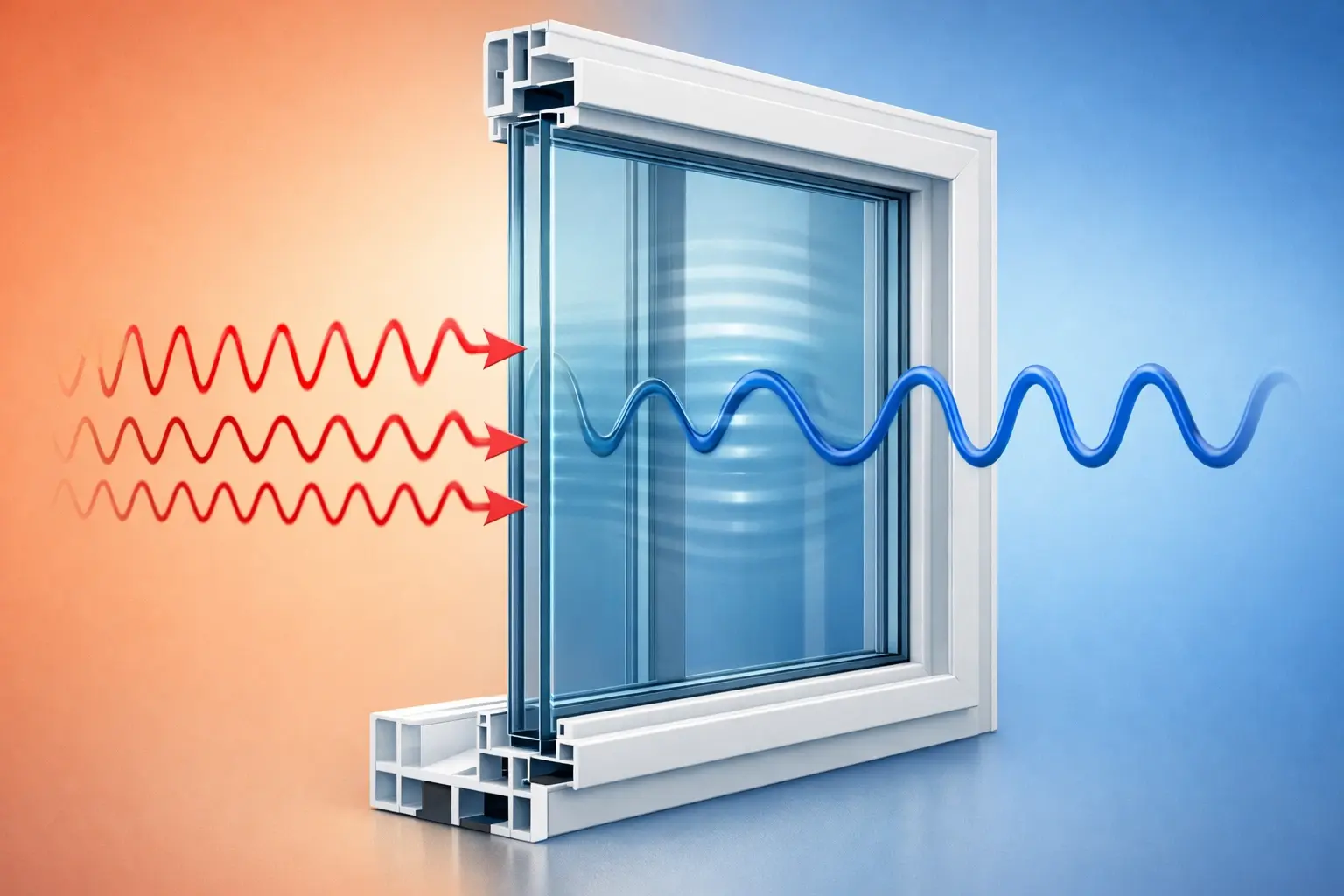
Low-frequency sound waves can vibrate standard glass, transmitting urban noise directly into your home.
The Mass Law: Why Heavier is (Actually) Better
There's a principle in acoustics called the Mass Law. It's refreshingly simple: the heavier your barrier, the harder it is for sound to make it vibrate.
In practical terms, doubling the weight of a pane of glass gives you roughly a 6dB improvement in sound reduction. That might not sound like much, but every 10dB reduction cuts the perceived loudness in half. So those extra decibels add up fast.
Standard double glazing typically uses 4mm glass panes. Some "acoustic" versions bump that up to 6mm. But here's the thing: even 6mm glass doesn't have enough mass to seriously tackle low-frequency rumbling. It's like trying to stop a charging bull with a tea towel.
This is where 10.8mm acoustic laminate glass comes into its own.
Laminated acoustic glass isn't just thicker — it's also got a special PVB (polyvinyl butyral) interlayer sandwiched between two sheets of glass. This interlayer is designed to absorb vibrations rather than transmit them. When a low-frequency wave hits it, the energy gets converted into heat within the PVB layer instead of passing through to the other side.
The result? A pane of glass that's heavy enough and resilient enough to stop those bus vibrations in their tracks. But here's where it gets interesting: even the best glass in the world won't give you proper silence on its own. You need a second trick up your sleeve.
The Air Gap: Your Secret Weapon
This is where soundproof secondary glazing completely changes the game.
The science behind secondary glazing is surprisingly elegant. When you install a second pane of glass inside your existing window frame — separated by a gap of 100mm or more — you create what acousticians call a "decoupled system."
Here's why that matters. When sound hits your primary window (the original sash window facing the street), it makes the glass vibrate. But instead of that vibration traveling directly into your room, it has to cross an air gap first. And air is a terrible conductor of vibrations.
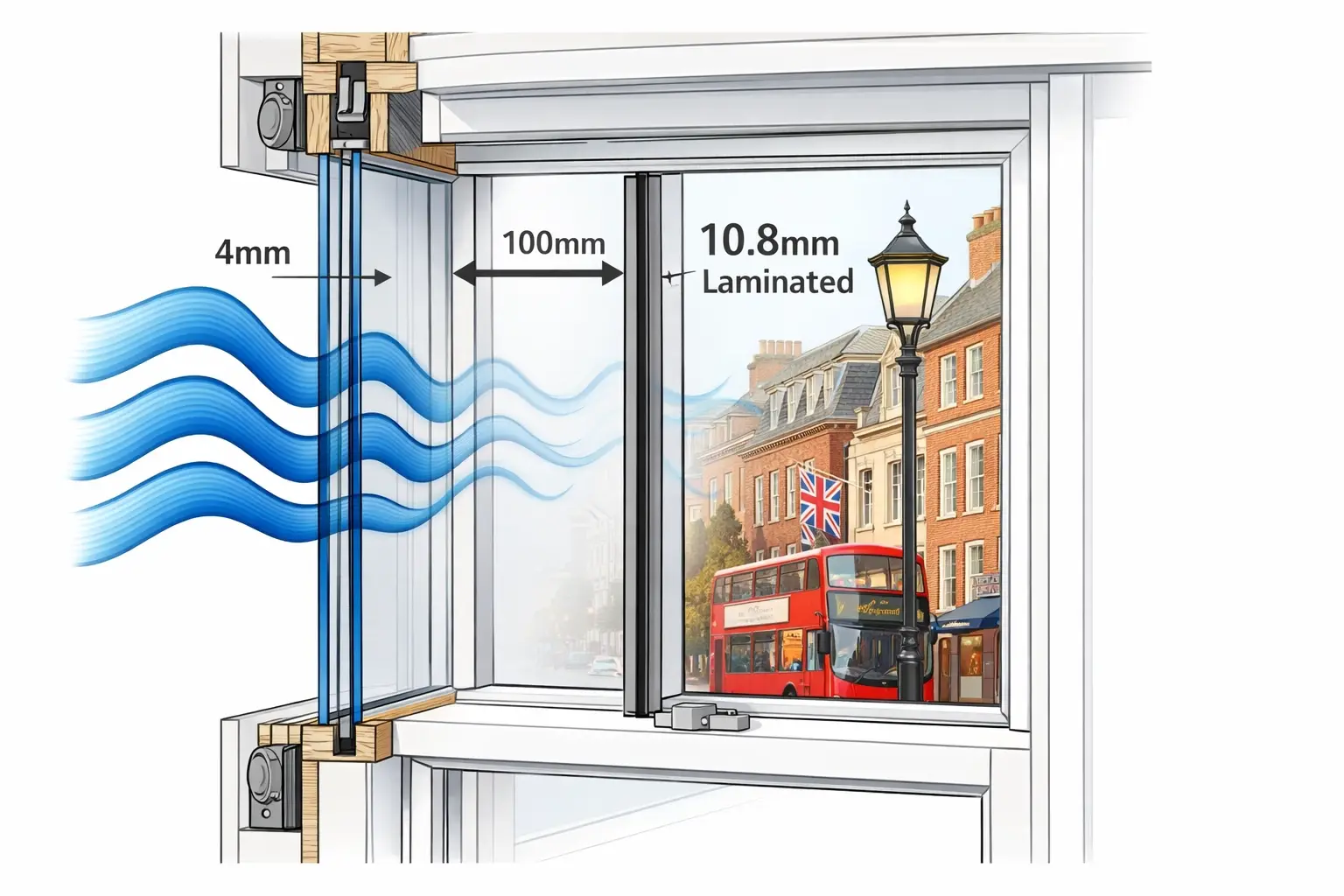
The 100mm+ air gap creates a decoupled system that breaks the chain of vibration between outer and inner panes.
Think of it like this: if you tap on one side of a brick wall, someone on the other side will feel the vibration travel through the solid brick. But if you leave a gap between two walls, the vibration dies in the air. The second wall stays still.
The same principle applies to secondary glazing. The 100mm air gap acts as a buffer zone that breaks the chain of vibration. By the time any sound energy reaches your inner pane of 10.8mm acoustic laminate glass, it's already lost most of its punch.
The bigger the air gap, the better it works — especially for low frequencies. A gap of 100mm to 150mm is the sweet spot for blocking those deep, rumbly sounds that standard double glazing just can't touch.
Real Results: What 54dB Actually Means
When we talk about noise reduction windows London homeowners actually need, we're talking about systems that can achieve up to 54dB of sound reduction.
To put that in perspective:
- A busy London street measures around 70–80dB
- A normal conversation is about 60dB
- A quiet library is around 40dB
- A whisper is roughly 30dB
If you're dealing with 75dB of traffic rumble outside and your secondary glazing knocks that down by 54dB, you're sitting in a room that registers around 21dB. That's quieter than a recording studio.
The difference is night and day — or more accurately, the difference between lying awake at 2am listening to night buses and actually sleeping through till morning. And unlike external sound insulation methods (like replacing your entire window or adding external shutters), secondary glazing is completely reversible. That makes it perfect for period properties and listed buildings, where planning permission can be a proper headache.
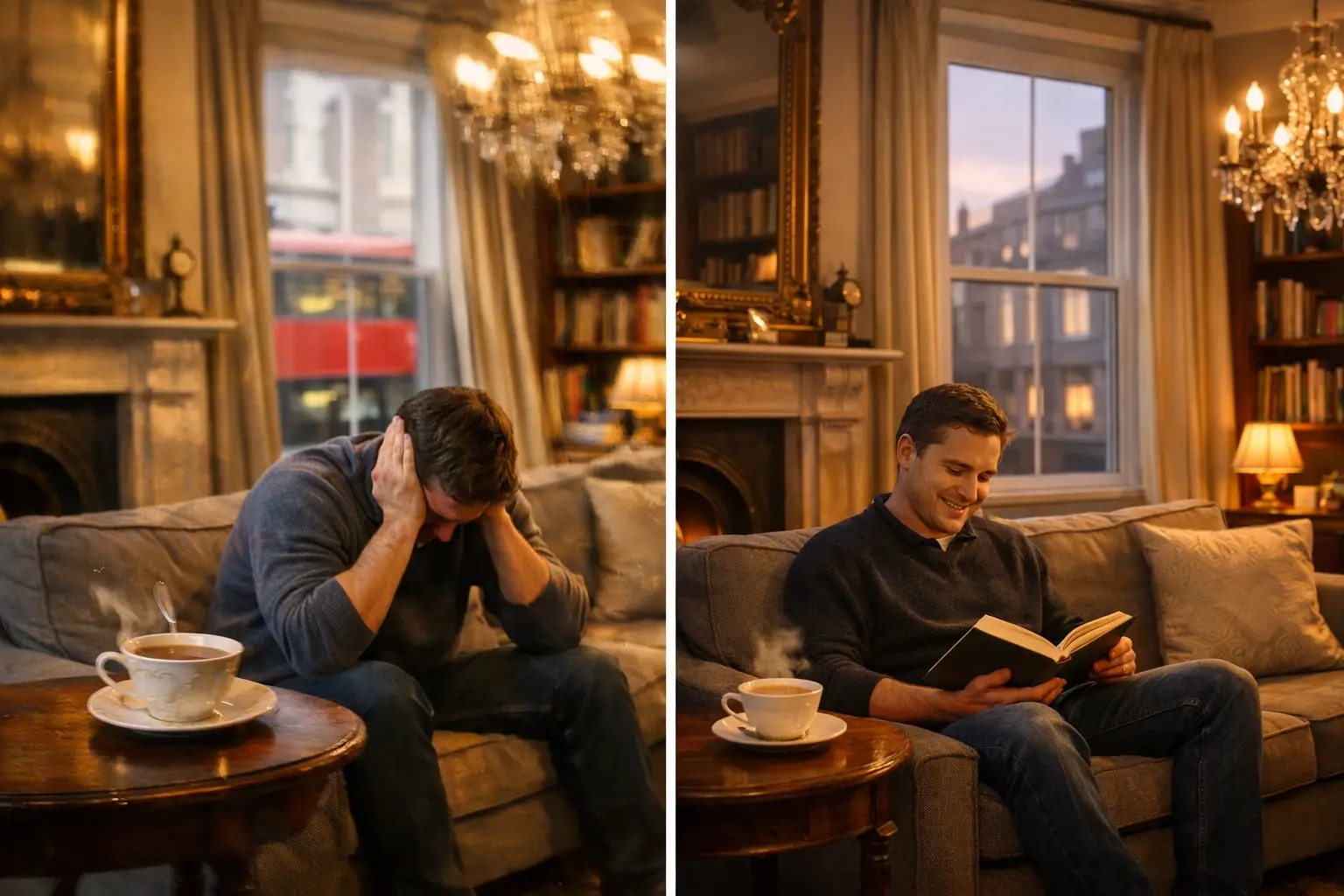
A Victorian living room transformed: secondary glazing delivers up to 54dB noise reduction without altering original features.
Why This Matters for Period Properties
If you own a Georgian terrace or a Victorian conversion in zones 1–3, you're stuck between a rock and a hard place. Your single-glazed sash windows are beautiful, often original, and in many cases protected by conservation rules. But they're also about as effective at blocking traffic noise as a doily.
You can't rip them out. You shouldn't replace them — both because of planning restrictions and because original features add serious value to period homes. But you also can't keep living with the constant background rumble of London life.
Secondary glazing with 10.8mm acoustic laminate glass is the compromise that actually works. It sits discreetly inside your existing window frame, barely visible from the street, and requires no external alterations. Most installations don't need planning permission at all because they're classified as internal improvements.
You keep your original sashes. You keep your period charm. And you finally get some bloody peace and quiet. If you're in Kensington or Chelsea, discover how our approach provides discreet soundproofing for period homes without compromising heritage.
Dealing with specific noise problems like trains or planes? Each noise type requires a slightly different optimisation of the same core system.
The Bottom Line
Blocking low-frequency noise isn't about spending more money on fancier double glazing. It's about understanding the physics and using the right combination of mass, air gap, and specialist glass.
Standard 4mm or 6mm glass doesn't have the weight to stop vibrations. A thin air gap (like the 12–20mm you get in most double glazing) doesn't provide enough decoupling. And without both working together, you're still going to hear every lorry that rumbles past.
But when you combine 10.8mm acoustic laminate glass with a 100mm+ air gap in a properly installed secondary glazing system, you're working with the physics instead of against it. You're adding mass where it matters, creating a decoupled barrier that breaks the vibration chain, and giving those long low-frequency wavelengths nowhere to go.
If you've been living with the rumble for too long and you're ready to do something about it, secondary glazing isn't just an option — it's the only option that actually works without ripping out your original windows.
And in a city as noisy as London, that's worth its weight in gold. Or should we say, worth its weight in 10.8mm laminated glass.
Related Articles
Secondary Glazing for Listed Buildings: The Ultimate Heritage Guide
How to apply these acoustic principles in Grade I and II listed buildings — without planning permission or touching original fabric.
The Silent Nursery: 54dB Noise Reduction for Better Infant Sleep
Why every decibel matters for infant brain development — and how the same physics delivers a genuinely quiet nursery.
Find Out How Much Noise You Could Eliminate
Use our free noise reduction cost calculator to see what secondary glazing could do for your London home.
Planning a project?
Get an instant estimate with our Secondary Glazing Cost Calculator or Book a Professional Sound Survey.
Related guides
Explore the dedicated London landing pages for the systems and property types covered above.
- Secondary glazing for sash windowsPurpose-built systems for London box sash windows — specs, prices and heritage detailing.
- Sliding secondary glazingHorizontal and vertical sliders for sash and casement windows — up to 51dB with full ventilation access.
- Secondary glazing for listed buildingsFully reversible, consent-friendly specifications for Grade I and Grade II properties.
- Traffic noise secondary glazingSpecs matched to road-noise frequency profiles on London’s busiest streets.