
The Silent Nursery: 54dB Noise Reduction for Better Infant Sleep
When you bring your baby home to a Victorian terrace on a bus route, you quickly realise that your beautiful period windows come with a soundtrack: the 3am siren, the 5am bin lorry, the perpetual diesel rumble that seems to vibrate through the floorboards.
And here's the thing nobody tells you until you're knee-deep in sleep deprivation: every decibel matters.
Not in some abstract, "Well, babies are adaptable" way. In a measurable, neurological, this is literally shaping your child's brain architecture way.
Let's talk about why a properly engineered secondary glazing system, one that delivers up to 54dB noise reduction, isn't a luxury. It's one of the smartest investments you'll make in your child's first years.
The Science of Baby Sleep (And Why London is Working Against You)
Newborns need 14–17 hours of sleep per day. By six months, they still need 12–15 hours. But here's what makes infant sleep different from adult sleep: they spend far more time in REM (rapid eye movement) sleep, the phase where neural connections are forged at an astonishing rate.
During deep sleep, an infant's brain is consolidating memories, processing language patterns, and literally building the synaptic pathways that will define cognitive function for life. Research shows that sleep disruptions during these critical windows don't just make babies cranky — they measurably impact memory formation, emotional regulation, and even immune system development.
Now consider the acoustic reality of urban London:
- A standard conversation: 60dB
- A bus accelerating past your window: 80–85dB
- Emergency sirens: 100–120dB
- Ambient street noise in Zone 2: 70–75dB baseline
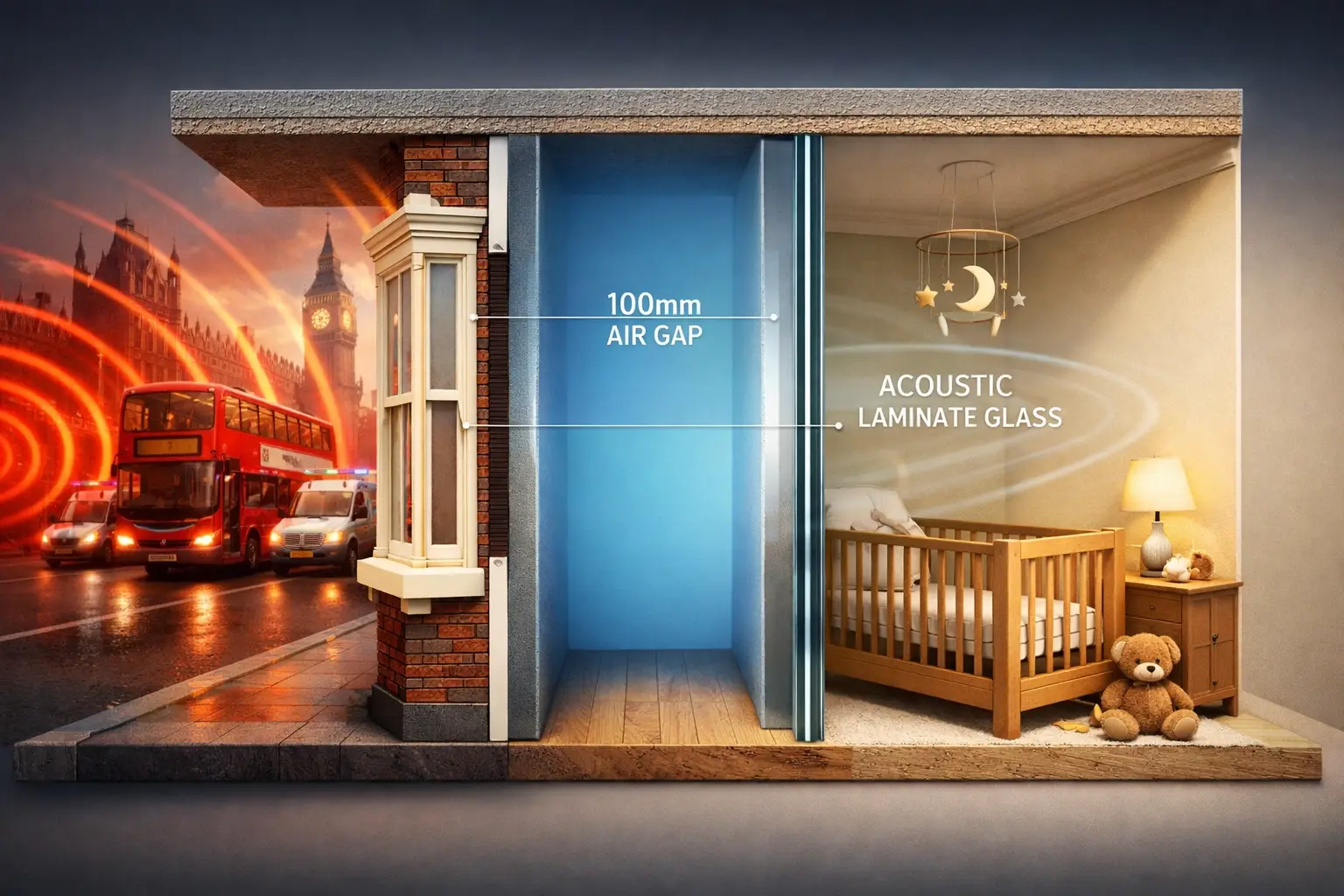
Secondary glazing with a 100mm+ air gap creates the acoustic barrier nurseries need against London's urban noise.
Your beautiful single-glazed sash windows? They're reducing that by maybe 10–15dB on a good day. Which means your nursery is sitting at a constant 55–65dB during the day, with spikes well into the 80s every time a motorbike roars past.
The WHO recommends no more than 45dB in bedrooms at night for quality sleep. For infants, who startle more easily and have shorter sleep cycles, that target is even more critical.
You're not being precious. You're being a neuroscientist.
What 54dB Reduction Actually Means (And Why the Air Gap is Everything)
When we talk about "up to 54dB reduction," we're not talking about foam panels or heavy curtains. Those might shave off 5–10dB if you're lucky. We're talking about acoustic laminate secondary glazing with a 100mm+ air gap — a fundamentally different beast.
Here's the physics: sound travels in waves. When a wave hits a barrier (your primary window), some energy is absorbed, some is reflected, but a lot of it vibrates the glass itself, transmitting noise into your room. With secondary glazing, you're creating a second barrier with a critical ingredient: dead air space.
That 100mm gap acts like a sound buffer. The first pane (your original window) stops the initial assault. The sound energy that does transfer has to cross a void where there's no medium to efficiently carry vibrations. By the time it reaches the second pane — 10.8mm of acoustic laminate glass — it's already been significantly dampened.
Acoustic laminate glass uses a PVB (polyvinyl butyral) interlayer between two sheets of glass. This viscoelastic layer absorbs vibration energy and prevents the pane from resonating like a drum skin. It's the same technology used in recording studios and concert halls.
When you combine thick acoustic laminate + a wide air gap + proper acoustic seals, you create what's called a "decoupled system." The two panes aren't vibrating in sync, so sound can't efficiently jump from one to the other.
The result? That 85dB bus roar becomes a 30–35dB background hum. The 100dB siren drops to a barely-noticeable 45–50dB. Your nursery goes from "urban assault course" to "countryside cottage."
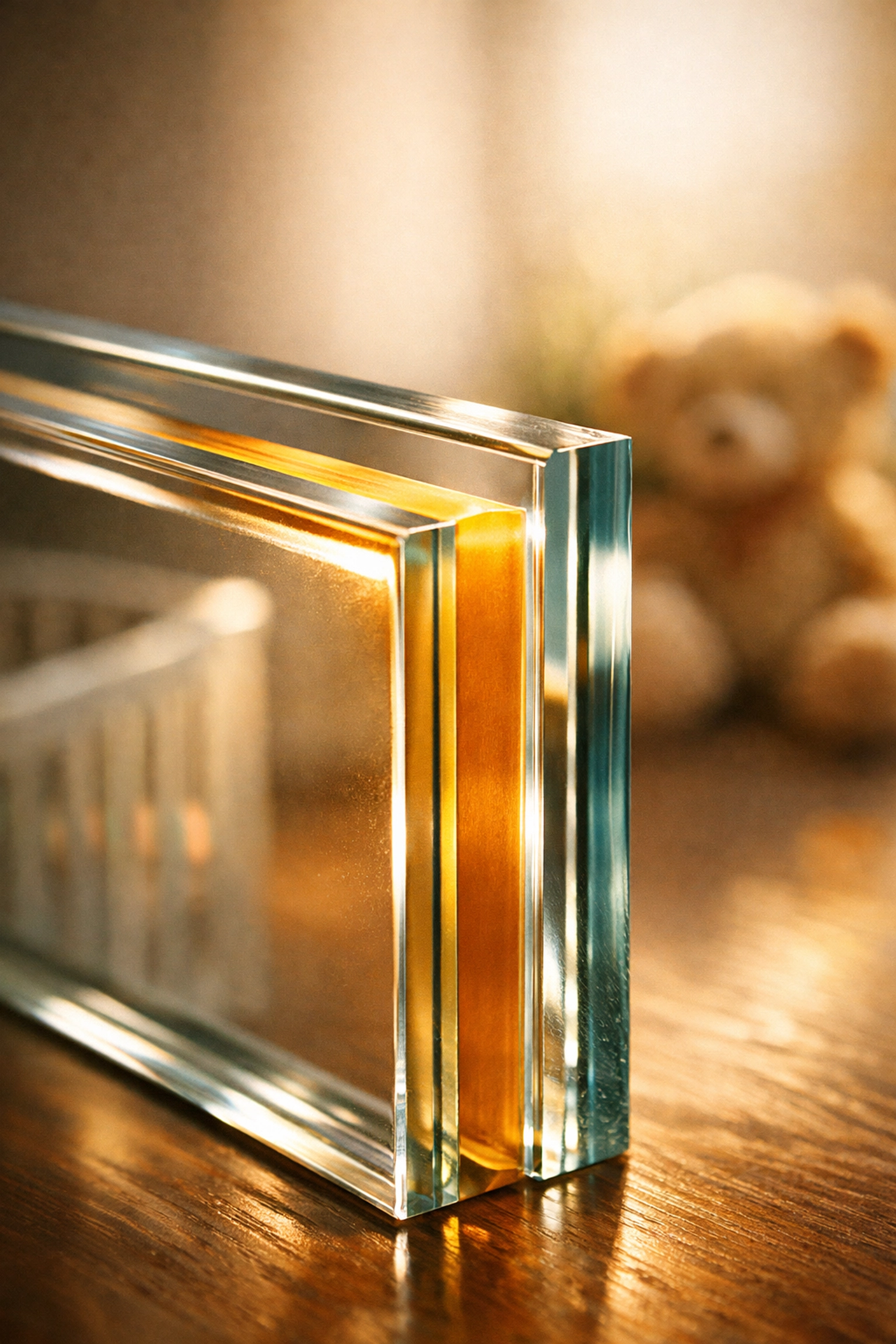
10.8mm acoustic laminate glass with PVB interlayer — the same technology used in recording studios.
Why This Matters More in the First Year Than You Think
Let's get specific about what happens when your baby actually sleeps in silence:
Sleep cycles lengthen. Infants have 50–60 minute sleep cycles (compared to 90 minutes in adults). Noise disturbances don't always wake them fully, but they disrupt the transition between light and deep sleep. In a quiet room, babies consolidate their cycles more effectively, leading to longer stretches of restorative sleep.
Cortisol drops. Chronic noise exposure, even at levels that don't wake a baby, keeps stress hormones elevated. Lower cortisol means better immune function, easier weight gain, and (crucially for parents) a calmer, more settled temperament during wake windows.
Language acquisition accelerates. During REM sleep, babies replay and process the speech patterns they've heard during the day. Undisturbed REM cycles = better neural encoding of phonemes, rhythm, and syntax. Some studies suggest a correlation between sleep quality in infancy and vocabulary size at age two.
You get your own sleep. Let's not pretend this is all altruistic. When your baby sleeps through a siren or a drunk argument at 2am, you sleep too. Parental sleep deprivation is linked to postpartum depression, impaired decision-making, and marital strain. A quiet nursery is a gift to the whole household.

A quiet nursery isn't a luxury — it's the foundation for healthy infant brain development.
The Period Home Problem (And Why Secondary Glazing is the Only Real Solution)
If you live in a listed building, a conservation area, or even just a Victorian/Edwardian home in a council that's precious about street aesthetics, replacing your windows isn't an option. Planning permission is a nightmare, and even if you get approval, you're looking at £15,000–25,000 for a full replacement that may not even match the noise reduction of a well-designed secondary glazing system.
Here's why secondary glazing is actually better for period properties:
It preserves the original windows. Those single-glazed sashes are part of your home's character. Secondary glazing sits discreetly on the interior, invisible from the street, maintaining the building's historic facade.
It's reversible. If you ever move or need to restore the original configuration, secondary glazing can be removed without damage. Try that with uPVC replacements.
It creates a deeper air gap. Modern double-glazing typically has a 12–20mm gap between panes. Our secondary systems install 100mm+ behind your existing window, creating a far more effective sound barrier. Physics doesn't care about aesthetics — more distance = less noise transmission.
It's faster and cheaper. A full room can be fitted in a day or two with no scaffolding, no disruption to the exterior, and a price point that's often half of window replacement.
For new parents in period homes, it's the rare solution that ticks every box: effective, affordable, preserving, and, most importantly, actually works.
What "Up to 54dB" Really Requires (Let's Be Honest About Variables)
We need to be transparent: not every window will hit 54dB reduction. That figure represents best-case performance with optimal conditions:
- 100mm+ air gap (the deeper, the better)
- 10.8mm acoustic laminate glass (not standard 4mm glass)
- Proper acoustic sealing around all edges (no gaps for sound to leak)
- Well-fitted primary windows (if your sashes are rattling in the breeze, we need to address that first)
In real-world installations, most of our clients see 42–48dB reduction on street-facing windows. That's still enough to take a 75dB bus route down to a whisper-quiet 27–33dB. On windows facing quieter courtyards or gardens, the reduction can absolutely reach 50–54dB because there are fewer extreme low-frequency challenges.
The point isn't to promise perfection. It's to promise transformation. And for new parents losing their minds to noise, the difference between 45dB and 54dB is academic — what matters is crossing the threshold from "my baby startles awake six times a night" to "we're finally sleeping."
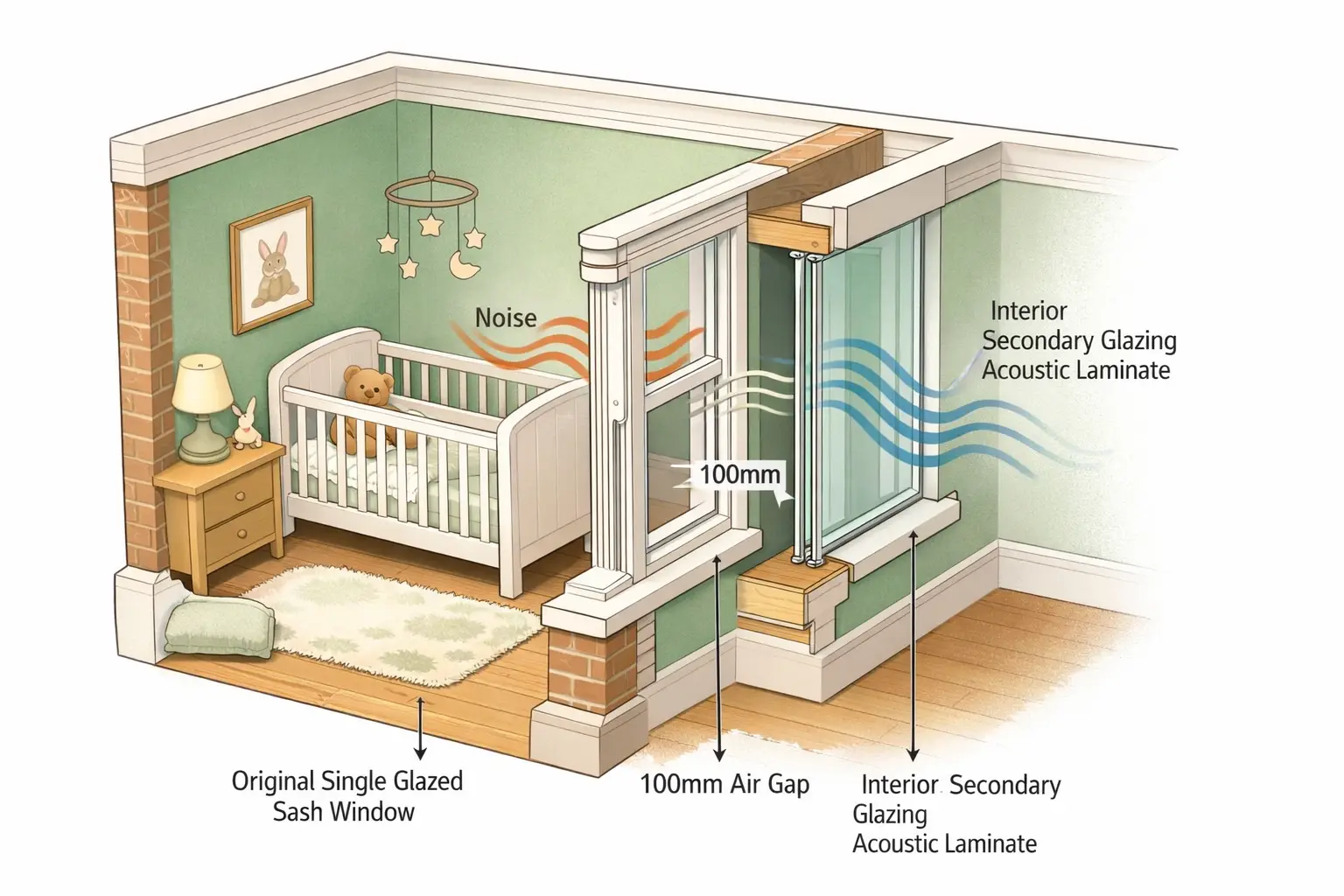
A well-designed secondary glazing system optimises mass, air gap, and sealing for maximum noise reduction.
The ROI You Can't Quite Quantify (But Feel Every Day)
Here's what we hear from parents three months after installation:
"She's napping for two hours now instead of forty minutes."
"We didn't realise how much the noise was affecting us until it stopped."
"Our Health Visitor commented on how calm he seems — we think it's the sleep."
"I can hear myself think during nap time."
You can't put a number on that. Well, you can: fewer GP visits for exhaustion-related issues, less money spent on white noise machines that don't actually work, better focus at work because you're not surviving on four hours of broken sleep — but it misses the point.
The real ROI is the morning you wake up and realise you all slept through the night. The afternoon nap that actually happens because a delivery van didn't shatter the silence at the critical 20-minute mark. The evenings where you and your partner can have a conversation in normal voices while the baby sleeps peacefully upstairs.
Your Move
If you're reading this at 3am with a baby who startles awake every time a car door slams, you already know you need to do something. The question isn't "Is this important?" — it's "How quickly can I make this happen?"
Secondary glazing isn't a six-month project. It's a consultation, a quote, and an install window (pun intended) of one to two days for an average nursery.
And if you're in a period property, wrestling with the impossible choice between preserving your home's character and protecting your baby's sleep? You don't have to choose.
You can have Edwardian elegance and a 54dB sound barrier. You can honour the original sashes and give your child the quiet they need to build a healthy brain.
Welcome to the silent nursery. Your whole family's about to sleep better.
Frequently Asked Questions
Will secondary glazing fit my sash windows?
Yes. Secondary glazing is designed to work with all window types, including Victorian and Georgian sash windows. It installs on the interior of your existing window frame without altering the original sashes. The slim aluminium frames are colour-matched to blend seamlessly with period features, and the panels can be opened independently for ventilation and cleaning.
Is secondary glazing safe for children?
Absolutely. Secondary glazing with acoustic laminate glass is actually safer than standard glass. The PVB interlayer holds the glass together if it's ever broken, similar to a car windscreen, preventing dangerous shards. The panels are securely fixed to the frame with child-safe locking mechanisms, and there are no accessible cords or chains. All our installations comply with UK building safety regulations.
How much noise reduction will I actually get in a nursery?
With 10.8mm acoustic laminate glass and a 100mm+ air gap, most nursery installations achieve 42–48dB noise reduction on street-facing windows. This typically reduces a busy London road (75dB) to whisper-quiet levels (27–33dB). Windows facing quieter areas can achieve up to 54dB reduction. The exact figure depends on your window condition, air gap depth, and sealing quality.
How long does installation take for one room?
A single nursery typically takes half a day to one full day to complete. There's no scaffolding, no exterior work, and minimal disruption. We recommend scheduling installation during a period when you can keep the baby in another room, as there will be some noise during fitting. Most parents plan it during a weekend visit to grandparents.
Do I need planning permission for secondary glazing?
In the vast majority of cases, no. Secondary glazing is classified as an internal improvement because it doesn't alter the external appearance of your building. This makes it ideal for listed buildings and conservation areas where external window changes would require Listed Building Consent. We always recommend checking with your local authority if you're unsure.
Related Articles
Secondary Glazing for Listed Buildings: The Ultimate Heritage Guide
Planning permission, glass specs, and installation steps for Grade I and II period properties — all without touching original fabric.
The Physics of Silence: How to Block London's Low-Frequency Rumble
The science behind mass law, air gaps, and PVB interlayers — and why they work together to defeat urban noise.
Ready to Create Your Silent Nursery?
Use our free calculator to estimate noise reduction and costs for your nursery windows.
Planning a project?
Get an instant estimate with our Secondary Glazing Cost Calculator or Book a Professional Sound Survey.