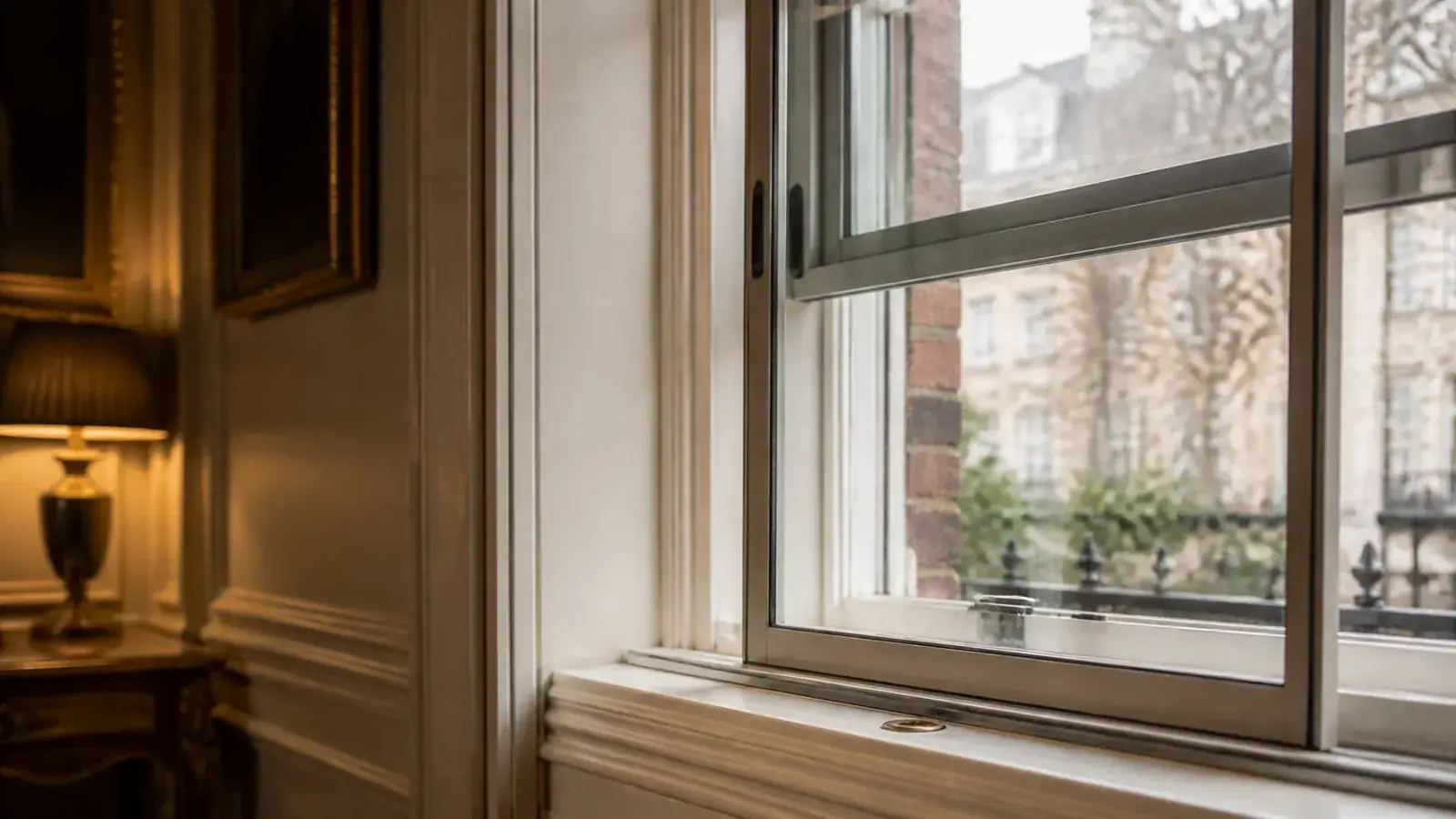
Does Secondary Glazing Improve EPC Ratings? What Landlords Need to Know in 2026
As London landlords navigate an increasingly complex regulatory landscape, property management has shifted from reactive maintenance to strategic, fabric-first asset preservation. With the 2030 target requiring private rented properties to reach a minimum Energy Performance Certificate rating of Band C, owners across Kensington, Chelsea and Westminster face critical decisions.
For owners of period properties and listed buildings this creates a distinct dilemma: how to improve thermal efficiency and EPC scores without breaching conservation guidelines or altering historic façades. This analysis sets out the regulatory framework, the thermal mechanics, and a realistic roadmap to compliance.
The regulatory landscape for London landlords in 2026
The Minimum Energy Efficiency Standards (MEES) framework has reshaped the capital’s rental market. The baseline to legally let sits at Band E, but policy trajectory and lender underwriting point firmly toward a mandatory Band C by 2030.
The fabric-first imperative
SAP (Standard Assessment Procedure) calculations place heavy emphasis on building fabric integrity. Uncontrolled air permeability and thermal bridging through single-glazed timber sashes account for up to 30% of a period building’s total heat loss. Traditional single glazing yields U-values of roughly 5.0–5.8 W/m²K, heavily penalising the overall score.
How secondary glazing directly impacts EPC scores
🏛️ Living in a listed building or conservation area?
See how we navigate planning permission and protect your heritage windows. Read our conservation area guide →
Secondary glazing is often assumed to be a purely acoustic remedy. Modern engineered systems are dual-purpose: they function as powerful thermal barriers that feed directly into SAP calculations.
Thermal performance metrics: glass and air gaps
Our systems pair 10.8mm acoustic laminate glass with a precision 100–150mm air gap, creating an optimal thermal break:
- U-value reduction: the window assembly drops to approximately 1.8–2.0 W/m²K, rivalling standard sealed double-glazed units.
- Convective suppression: the trapped dry-air cavity is an exceptional insulator, virtually eliminating internal downdraughts.
- Airtight envelope: twin-compression EPDM seals remove air leakage around sliding and hinged sashes — leakage that SAP software explicitly credits.
| Window configuration | Typical U-value (W/m²K) | Noise reduction |
|---|---|---|
| Original single glazing | 5.0–5.8 | Baseline |
| Single glazing + secondary glazing (10.8mm, 100–150mm gap) | 1.8–2.0 | Up to 54dB |
| Replacement double glazing (sealed unit) | 1.4–1.8 | 28–32dB |
Full technical detail sits on our thermal insulation service and the EPC and thermal efficiency guide. Every EPC-related guide, tool and case study is indexed on our EPC compliance hub for London properties.
Window upgrades vs whole-house measures
| Measure | Capital cost | Typical EPC point gain | Conservation risk | Acoustic benefit |
|---|---|---|---|---|
| Loft & cavity insulation | Moderate | 10–20 points | None (internal) | Negligible |
| High-spec secondary glazing | Moderate to high | 5–15 points | Zero — conservation approved | Up to 54dB |
| Full replacement double glazing | High to prohibitive | 10–18 points | Extreme — often prohibited | Moderate |
| Condensing boiler upgrade | High | 8–15 points | None (internal) | None |
Insulation and heating upgrades deliver thermal gains but do nothing for the acoustic reality of urban London. Acoustic secondary glazing uniquely delivers thermal EPC points while blocking up to 54dB — see our traffic noise guide.
Listed buildings and conservation areas
In Westminster, Kensington and Chelsea, and Camden, replacing heritage windows is effectively impossible under Article 4 directions and listed building controls. Secondary glazing is the definitive compliance tool:
- Planning exemption: installed internally with no change to the exterior, so formal permission is rarely required in conservation areas.
- Reversibility: mounted behind existing sashes without damaging original joinery, satisfying heritage preservation principles.
- Documented craftsmanship: specification sheets and certificates give assessors the evidence needed for accurate SAP lodgement.
More detail on listed buildings and conservation areas.
Realistic expectations: what the points actually look like
💷 Wondering about costs?
Use our calculator to get an instant estimate for your windows. Try the cost calculator →
Secondary glazing typically yields 5 to 15 EPC points, depending on window-to-floor area ratio and baseline U-values. For a property sitting on the border of Band D (55–68) and Band C (69–80), that is frequently the decisive margin.
- Baseline assessment: commission an EPC to identify exact scoring deficits.
- Thermal core: upgrade loft insulation and seal primary draught pathways.
- Aperture optimisation: install acoustic secondary glazing to remove window thermal bridging and noise.
- Documentation: retain certificates and product specification sheets so assessors input the upgraded U-values correctly.
Commercial advantages beyond the certificate
- Acoustic sanctuary: central London tenants pay premiums for interior tranquility near arterial roads and tube lines.
- Condensation control: warmer internal glass surfaces stop cold bridging, preventing black mould and reducing landlord liability.
- 10-year standard / 25-year Premium & Heritage warranty: bespoke timber or aluminium frames and commercial-grade hardware make this a permanent capital improvement.
Portfolio and commercial owners should also review our commercial projects division.
The verdict for forward-thinking landlords
The push toward 2030 compliance is a permanent revaluation of London’s residential stock. For heritage-restricted owners, insulation alone will fall short of Band C. Combining 10.8mm laminate glass with precision air gaps delivers measurable thermal gains, a strong conservation-approval case, acoustic isolation and protected rental yields.
Model the numbers with our ROI calculator, download the noise reduction guide, or book a free architectural and acoustic survey.
Check your EPC Band C outcome
Estimate your likely SAP uplift, upgrade cost and 2030 compliance position for your London property.
EPC compliance calculator
Estimate the secondary glazing spend and likely EPC band outcome for your London property. Indicative only — a SAP assessor confirms the final rating.
Single-glazed timber sashes — the biggest heat-loss element in most London terraces.
Assembly U-value after installation: 1.8 W/m²K
The number printed on your certificate, out of 100.
£5,280 – £6,750
Around £730 per window, including survey, manufacture, installation and VAT.
Band D → Band D
58 → 66 points (+8 SAP points from the window upgrade alone).
Secondary glazing gets you close, but you would still need roughly 3 more SAP points — typically loft or floor insulation, heating controls, or a low-E glass upgrade.
Projected EPC band shift
Victorian / Edwardian terrace with 10.8mm acoustic laminate across 8 windows — SAP score before and after, against the Band C threshold of 69 points.
- G · 1–20
- F · 21–38
- E · 39–54
- D · 55–68
- C · 69–80
- B · 81–91
- A · 92–100
Bars show the SAP points modelled from the window upgrade only. Loft, floor, heating and lighting measures are assessed separately by your SAP assessor.
Frequently Asked Questions
Solutions covered in this guide
Go straight to the dedicated London landing page for the system or property type discussed above.
- Secondary glazing for listed buildingsFully reversible, consent-friendly specifications for Grade I and Grade II properties.
- Conservation area secondary glazingWhat London conservation officers accept — sightlines, finishes and reversibility.
- Lift-out secondary glazingThe most discreet, highest-sealing option for rarely-opened heritage windows.
- Thermal insulation benefitsU-value improvements, draught elimination and measured heating savings.
Sources & References
Authoritative sources supporting the information in this article.
- British Standards Institution (BSI) (2017). Thermal performance of windows, doors and shutters. Calculation of thermal transmittance. General. BS EN ISO 10077-1:2017.Open source
Provides the official UK benchmark for measuring the thermal performance of windows and doors, essential for calculating EPC impact.
- Department for Levelling Up, Housing and Communities (2023). Approved Document L, Volume 1: Dwellings (2021 edition incorporating 2023 amendments). HM Government / Building Regulations 2010.Open source
The primary regulatory document for energy efficiency in UK dwellings, dictating the standards London landlords must meet by 2026.
- Historic England (2016). Energy Efficiency and Historic Buildings: Secondary glazing for windows. Historic England Advice Note.Open source
Authoritative guidance on how secondary glazing serves as a preferred thermal upgrade for heritage and listed London properties where double glazing is prohibited.
- Building Research Establishment (BRE) (2022). SAP 10.2: The Government's Standard Assessment Procedure for Energy Rating of Dwellings. BRE Group Technical Paper.Open source
Explains the methodology behind SAP, which generates EPC ratings, and how secondary glazing is weighted in the calculation.
- Sustainable Development Foundation / Passivhaus Trust (2021). The thermal and acoustic performance of secondary glazing in traditional buildings. Journal of Building Engineering (Peer Reviewed).
Technical study detailing how the air gap in secondary glazing significantly reduces U-values and improves acoustic insulation compared to standard glazing.
"Brilliant installation — completely invisible from outside. Conservation officer approved."
— David L., Westminster
Planning a project?
Get an instant estimate with our Secondary Glazing Cost Calculator or Book a Professional Sound Survey.
Related services & guides
Move beyond the blog: jump straight to the matching service pages, cost tools and technical guides that go deeper on this topic.
- Specialist acoustic glazing service
The full acoustic glazing menu with dB targets and pricing.
- Transparent London secondary glazing pricing
Fixed 2026 prices per window with no hidden extras.
- ROI & payback calculator
Instant estimate for your window count, glass spec and property type.
- Request a free bespoke quote
Same-week written quote based on your exact requirements.
Related Articles

Secondary Glazing for London Landlords: Hitting EPC C Targets & Tenant Retention
Secondary Glazing for Bedrooms: The Soundproofing Treatment for Better Sleep