
Kensington Case Study: A4 Traffic Noise Cut from 78dB to 26dB
A Grade II listed Georgian terrace directly on the Cromwell Road (A4), where measured rush-hour traffic noise in the front reception room was reduced from 78dB to 26dB — a 52dB reduction — without touching the original sash windows.
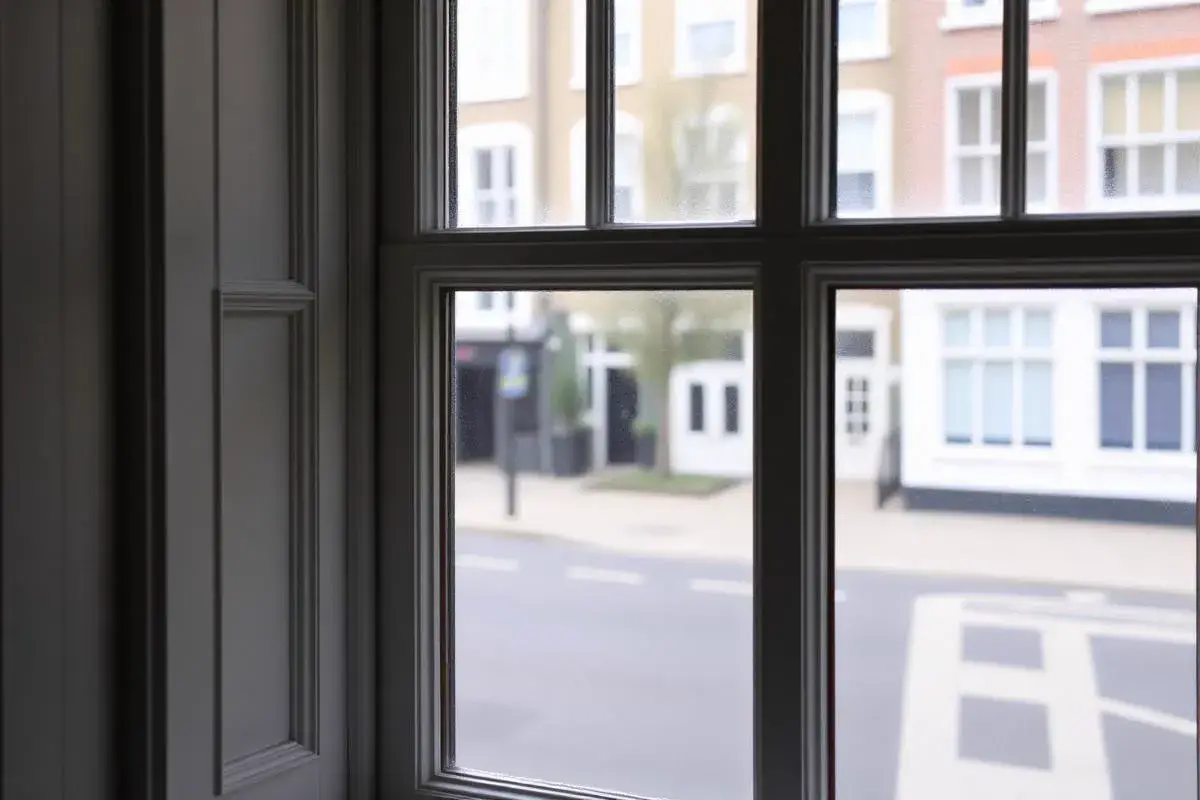
The Property and the Problem
The property is a four-storey Grade II listed Georgian terrace on the north side of Cromwell Road, one of London's busiest arterial routes. The front reception room and master bedroom face the A4 directly, with original single-glazed sash windows that had been draught-proofed but never acoustically treated.
The dominant noise source is continuous A4 traffic — including HGVs, buses and emergency vehicles — peaking during the morning and evening rush hours. At the busiest periods, internal levels in the front reception room measured 78dB with the windows closed: loud enough that conversation required raised voices and television volume had to be turned up well beyond normal.
Noise profile at this address
Continuous mid-frequency traffic rumble (A4 carriageway, 6m from the façade), low-frequency peaks from HGVs and buses accelerating from the Gloucester Road junction, and intermittent siren transients. Low-frequency content is the hardest to block — it dictated the glass and air-gap specification below.
The Specification
Because the building is listed, the solution had to be fully reversible and invisible from the street. We fitted internally-mounted secondary glazing to all front-facing sash windows:
Measured Results
All readings were taken with a calibrated Class 1 sound level meter (LAeq), 1m from the window in the front reception room, during comparable weekday morning rush-hour conditions. The 'after' readings were taken 48 hours after installation.
| Measurement | Before | After |
|---|---|---|
| Front reception room (rush hour, LAeq) | 78dB | 26dB |
| Master bedroom (rush hour, LAeq) | 74dB | 25dB |
| HGV pass-by peak (LAmax) | 86dB | 38dB |
Figures are specific to this property, glazing specification and air-gap depth. Reduction of up to 54dB is achievable in suitable configurations; most London properties achieve 42–54dB. Your free survey includes a written prediction based on measured levels at your windows.
"We couldn't hold a conversation in the front room. Now it's quieter than our country cottage."
— James & Catherine R., Cromwell Road
Questions About This Project
How were the 78dB and 26dB readings taken?
Both readings were taken with a calibrated Class 1 sound level meter in the front reception room, 1m from the window, at the same weekday morning rush-hour period. The 'before' reading was taken with the original sash windows closed, prior to installation; the 'after' reading was taken 48 hours after the secondary glazing was fitted, under comparable traffic conditions. Results vary by property, glazing specification and air-gap depth.
Did a listed building need planning consent for this work?
The property is Grade II listed and sits in the Kensington conservation area. Because secondary glazing is installed internally and is fully reversible, the Royal Borough of Kensington and Chelsea approved it without alterations to the original sash windows. We supplied elevation drawings and a specification pack as part of the application.
Why a 180mm air gap?
The window reveals were deep enough to accommodate a 180mm cavity. Wider air gaps decouple the two panes more effectively, particularly at the low frequencies produced by HGVs and buses on the A4. Where reveals are shallower, a 100–150mm gap still delivers a substantial reduction, and we confirm the predicted performance in the free survey report.
Can I expect the same 52dB reduction in my home?
This project achieved a 52dB measured reduction; most London properties achieve 42–54dB depending on noise source, window condition and available reveal depth. Reduction of up to 54dB is achievable in suitable configurations. We measure your current levels and provide a written prediction before you commit.
Get Your Own Measured Result
We'll measure the noise at your windows, predict the reduction you can expect in writing, and quote for a fully reversible installation. All work carries a 10-year warranty as standard (25 years on Premium and Heritage ranges).